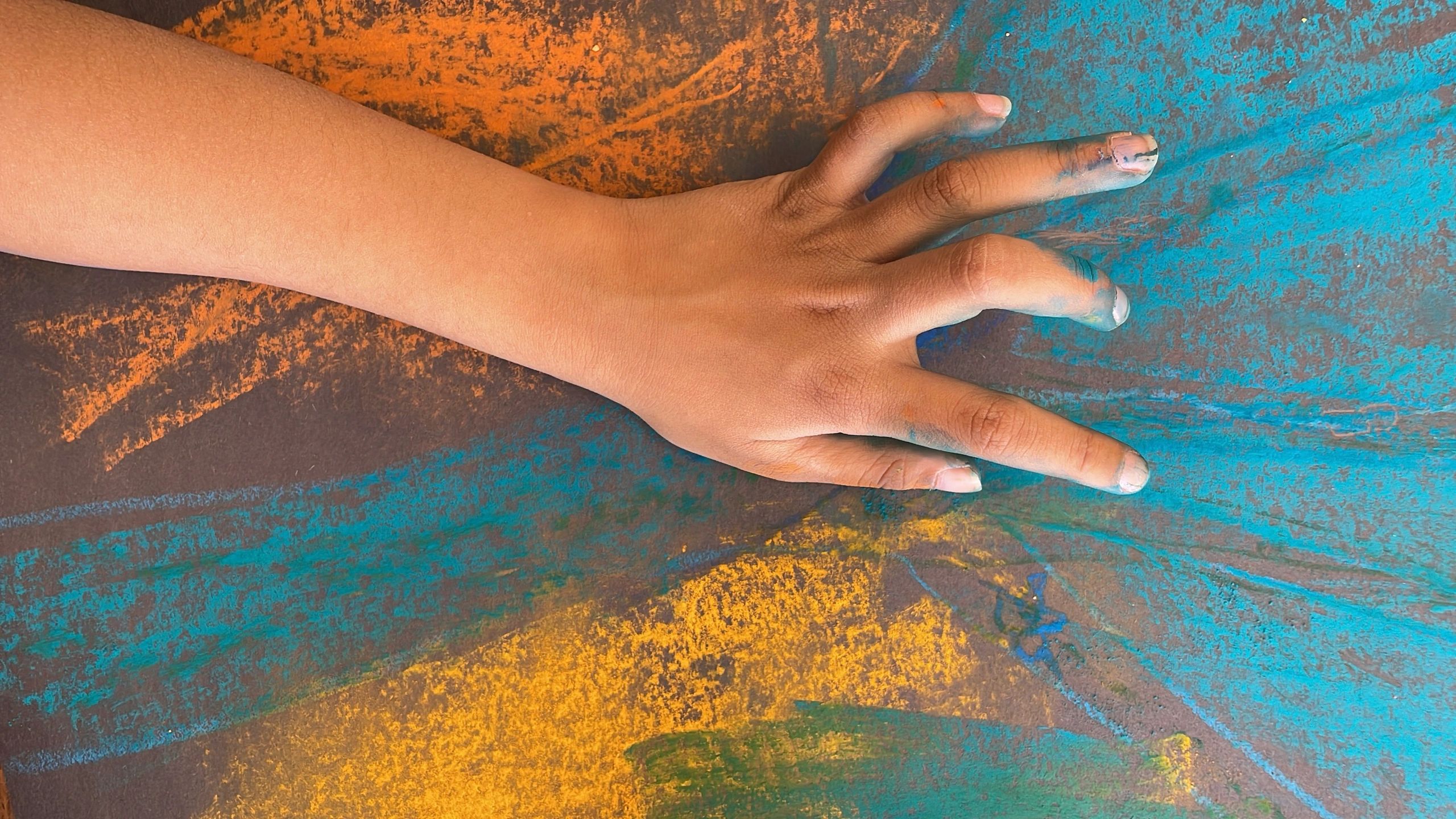
The Arts are a fundamental form of human expression, integral to all peoples and cultures and over time. The arts are implicit and embodied languages through which human experience shared and understood; They allow us to explore who we are, where we come from, what matters to us and what we long for. The arts are about identity and belonging, and the relationship of the self to community and the world. As such, participation in the arts has many benefits that impact all areas of our lives and learning. The arts are therefore an essential part of an education system within a democracy that seeks to develop children's'"full individual potential", and to meaningfully contribute within a democratic, healthy and pluralistic society and a sustainable and prosperous economy (BC School Act Preamble).
There is a wealth of research that underscore the essential role of the arts in education for children’s creative, cognitive development and their social and emotional growth and wellbeing. The arts are instrumental to the purposes of education within BC, to support a healthy, pluralistic and democratic society as well as a prosperous and sustainable economy (BC School Act). Despite this, funding constraints and a narrowing of educational purpose to one of economic return over human flourishing, continues to erode meaningful access to the arts in schools. This bibliography provides an overview of some of the literature on the essential role of the arts in education for your reference.


The arts are essential to human experience and fulfillment
Participation in the Arts and culture is a universal human right
- The right to engage in cultural production and to enjoy the arts is a fundamental human right. Article 27, Universal Declaration of Human Rights (1949).
- The UN convention on the rights of the child obligates member states to promote equal opportunity for children to develop their full personalities and talents including participation in artistic and cultural life. Article 29 & 31, Convention on the Rights of the Child (1989) ratified by Canada in 1991.
- Cultural rights are indivisible and interrelated to other human rights. Margareta Aspan, “Article 31- the Forgotten Right to Cultural Rights and the Arts in The Rights of the Child: Legal, Political and Ethical Challenges, Rebecca Adami, Anna Kaldai and Margareta Aspan, Eds. (2023) and Maria Corbett, Children’s Right to Culture: A paradigm shift. Arts in Education Portal.
- The arts are an intrinsic part of our human social and emotional experience. Dewey, John. (1934) Art as Experience. Perigree Books, 1980; Dessanyake, Ellen. (1992). Homo Aestheticus: Where Art Comes from and Why. University of Washington Press.
.jpg/:/rs=w:400,cg:true,m)
The arts support a healthy, democratic society
Arts and Cultural expression is linked to social justice and political empowerment
- “As democracy depends on civil society . . . so civil society depends on the arts . . . democracy ultimately rests on the arts’ commitment to free creativity, liberal diversity, and unfettered imagination. A government that supports the arts and humanities is not engaging in philanthropic activity but assuring the conditions of its own flourishing.” Benjamin Barber. In Commission on the Arts. (2021) The Arts and Public Education. American Academy of Arts and Sciences.
- A new EU Commission report directly links participation in the arts to active democracy and social cohesion. EU Commission. (2023) Cultural and Democracy, the Evidence.
- Recent polling by Nanos Research finds that Arts and cultural engagement increases a sense of belonging in Canada. Nanos Research (2025)
- Arts education fosters “Imaginative Understanding”, one of the 3 capabilities alongside critical thinking and world citizenship identified by Nussbaum as central to the “cultivation of humanity in today’s interlocking world.” Maguire, Cindy. “The Capabilities Approach and Citizenship Education: What the Arts Have to Offer.” Prospero: A Journal of New Thinking in the Philosophy of Education Vol 14, 2008.
- Youth with high arts engagement are more likely to vote, volunteer and engage in local politics. The Arts and Achievement in At-Risk Youth: Findings from Four Longitudinal Studies, National Endowment for the Arts, 2012. and National Endowment for the Arts (2007)The Arts and Civic Engagement: Involved in Arts, Involved in Life.
Arts engagement Fosters empathy and intercultural understanding
- UNESCO has highlighted the important role of arts education in promoting intercultural understanding in a rapidly changing world. Seoul Agenda: Goals for the Development of Art Education from the Second World Conference on Art Education, UNESCO, 2010)
- According to a 2021 survey, 94% of Canadians agreed that arts, culture, and heritage organizations have a critical role to play in addressing reconciliation, racial justice, and gender inequality. Reconsidering Museums (2021)
- Neuroscientists link arts engagement and the attention to other perspectives as key to developing the capacity for empathy in the brain. Bazalgette, Peter. The Empathy Instinct: How to Create a More Civil Society. John Murray Publishers, 2017; Bazalgette, Arts, Culture and Empathy lecture, January 2017; James Catteral,“ A Neuroscience of Art and Human Empathy”, (draft) 2011.
The arts are future shaping
Arts and Cultural expression is linked to social justice and political empowerment
- Freedom, autonomy and opportunity to practice art and culture is a declared right of Indigenous People, including in education. Article 11 and 15, United Nations Declaration on the Rights of Indigenous People.
- Art and cultural practices are integral to indigenous ways of knowing; they constitute a foundational literacy through which history, community, spirituality and cultural regeneration is expressed. Access to culturally appropriate curriculum is an educational mandate of the Canadian Truth and Reconciliation Commission. Item 10.3 Truth and Reconciliation Commission (2016).
- Indigenous cultural resurgence and political empowerment are related. Davidson, S. F.& R. Davidson, (2018) Potlatch as Pedagogy: Learning through Ceremony. Portage and Main Press.
The arts hold our social imaginaries, our values, who we are and who we aspire to be.
- The arts and culture are critical for positive future orientation by fostering the capacity to Aspire. Arjun Appadurai. (2004). The Capacity to Aspire: Culture and the Terms of Recognition. In Culture and Public Action. V. Rao & M. Walton. Eds. Stanford University Press
- Art is more than expression or creativity, it is a place for self- reflection and transformative dialogue with and for the world. Gert Biesta. (2017) What if? Art Education beyond expression and creativity.
- In Art, Artists and Pedagogy. Routledge.
The arts support mental health and wellbeing
- ·A recent Canadian study demonstrated the link between arts engagement and health and wellbeing, Canadians’ Arts Participation, Health and Well-Being.
- A WHO literature review links arts engagement to improved health and well-being across life-span. Fancourt. D, & S. Finn. (2019) What is the evidence on the role of the arts in improving health and well-being? A scoping review. World Health Organization.
- Quality arts education increases the expressive capacities and emotional regulation of children who have experienced trauma. Heart: Healing and education through the arts. Save the Chilren.org
- Evidence-based research demonstrates a relationship between the arts, increased self-confidence, self-worth and resilience or grit. Upitis, Rena. Arts Education for the Development of the Whole Child. Kinston: Queens University, 2011; Hetland, Winner, Veenema and Sheridan, Studio Thinking 2: The Real Benefits of Visual Arts Education. Harvard University Press, 2013
- Arts engagement is correlated with higher self-esteem across all arts disciplines. Mak, H. W. & D. Fancourt. (2019) Arts engagement and self-esteem in children: results from a propensity score matching analysis.
The arts build capacities for student success
Arts education in childhood improves social and academic achievement in school
- High arts engagement has a strong correlation with improved life outcomes for disadvantaged youth in academic achievement, employment opportunity and civic engagement. The Arts and Achievement in At-Risk Youth: Findings from Four Longitudinal Studies, National Endowment for the Arts, 2012.
- Regular engagement in Arts activities for pre-school and elementary students positively associated with social skills and academic success. National Endownment for the Arts. (2025) Snapshots of Arts Education in Childhood and Adolescence.
- Early childhood exposure is predictive of ongoing interest and engagement in the arts. Kisida, B., D. H. Bowen & J. P. Greene (2018) Cultivating interest in art: Causal effects of arts exposure during early childhood. Early Childhood Quarterly Review, Vol. 45.
- Education in the arts enhances the underlying brain processes that support learning; sensory, attentional, cognitive emotional, motor. Jensen, Eric. Arts with the Brain in Mind, Association for Supervision and Curriculum Development, 2001.
- Learning through the arts improves academic achievement for all children. Fowler. "Strong Arts Strong schools: The promising potential and short-sighted disregard of the arts in American schooling", Educational Leadership: Strategies for Success 52.3. Oxford University Press, 1996; Upitis, 2002.
Arts education respects multiple intelligences and allows for inclusive learning
- Education in the arts honours and supports the development of multiple intelligences. Gardner, Howard. “The Happy Meeting of Multiple Intelligences and the Arts.” Harvard Education Letter Vol. 5.6, 1999.
- Arts education reaches students that are hard to reach. Kreger Silverman, Linda. “At-risk Youth and the Creative Process,” Gifted Development Centre. Fiske Edward B., Ed. Champions of Change: The Impact of the Arts on Learning, Arts Education Partnership, 1999.
- The arts are shown to increase academic engagement and achievement for children with learning disabilities and for ELL students. Menzer, Melisa. The Arts in Early Childhood: Social and Emotional Benefits of arts, National Endowment for the Arts, 2015.
The arts are essential to a thriving economy
The Arts improve Student Career Opportunities
- Creativity is widely recognized by business and educational leaders as the primary skill set needed for the 21st century economy. Creativity Unleashed: Taking Creativity out of the Laboratory and into the Labour Force, 2011-2012 Action Canada Task Force Report, 2012. Ready to Innovate, Conference Board, 2008. Policy Research Group; The Creative Economy: Concepts and Literature Review Highlights, May 2013.
- Participation in the arts develops creative habits of mind. Hetland, Winner, Veenema and Sheridan, Studio Thinking 2: The Real Benefits of Visual Arts Education, Harvard U P, 2013; Winner and Vincent Pancrin, Art for Art’s Sake? The Impact of Arts Education, OECD, 2013; Neuroeducation: Learning, Arts and the Brain: Findings and Challenges for Educators and Researchers from the 2009 John Hopkins University Summit, Dana Foundation, 2009.
- Canada’s global competitiveness is compromised by declining innovation capacity according to recent World Economic Forum results. “Poor Innovation Ranking Dims the Light on Canada’s Competitiveness and Prosperity,” Conference Board of Canada, 2012.
- Canada ranks 24 out of 28 countries and well behind the OECD average for compulsory arts as a percentage of instructional time for 9-11 year-olds. Winner and Vincent-Pancrin, Art for Art’s Sake? The Impact of Arts Education, OECD, 2013.
The Arts supports visual literacy, human creativity and connection in a mediated world
- Neuroscientists are linking increased emphasis on technology to the decrease in right brain capacities that include creativity, empathy and big picture thinking. McGilchrist, Iain. The Master and his Emissary: The Divided Brain and the Making of the Western World. Yale University Press, 2009.
- Emerging research shows that the use of AI diminishes human capacity for creativity and connection at the core of artistic experience and value. Tyler Woods, What LLM’s are Quietly doing to Creativity: How AI makes it harder to think differently. Psychology Today May 8, 2026
- Art is important because of its relational connection to the human experience. May Reinhart, E. The trouble with AI art isn’t just lack of originality. It’s something far bigger. The Guardian. May 20, 2025.
- Students must develop visual literacy and a critical understanding of how imagery shapes and informs our values and beliefs. Bamford, Ann. The Visual Literacy White Paper. Adobe Systems Inc., 2003.
- Oring, Stuart. “A Call for Visual Literacy,” The Free Library. Davis Publications, Inc. 2000.
Art and culture is an economic driver
- The United Nations has identified the creative economy as one of the world's fastest growing sectors for income generation, job creation and export earnings. Government of British Columbia, Factsheet: Arts, Culture and the Creative Economy 2018.
- Arts and culture are an important indicator of economic competitiveness and growth in leading economies. Otis Report on the Creative Economy. Los Angeles Economic Development Corporation, 2017.
- Investment in the arts yields positive returns of up to ten times when accounting for direct, indirect and induced benefits. A Strategic and economic business case for investment in the arts, Business for the Arts, 2009.
The arts are a critical part of the BC and Canadian economy.
- The arts have a greater impact on the economy than oil and gas, construction and manufacturing. Canadian Chamber of Commerce, Artworks: The Economic and Social Dividends from Canada’s Arts and Culture Sector October 28, 2025.
- BC’s total culture GDP in 2014 was 3% of BC’s GDP or about $6.7 billion, a $1 billion increase since 2010. Government of British Columbia, Arts and Culture Facts and Stats, 2018.
- Statistics Canada data released February 2018 shows BC’s total culture GDP to have grown to $7.2 billion. Statistics Canada, Provincial and Territorial Culture Indicators, 2016, Feb. 2018.
- BC has the highest concentration of artists and cultural workers in Canada. Hill, 2016. The growth in culture sector jobs was 7.1% in 2016 from the previous year, compared to a 4.1% increase economy wide. Statistics Canada, Provincial and Territorial Culture Indicators, 2016, Feb. 2018.
- Arts and culture has 3 times more impact on tourism than other forms of tourism. The Canada Council for the Arts. Impact of the Arts.